
Is Las Terrenas Safe in 2026? A Realistic Guide for Buyers, Families and Retirees

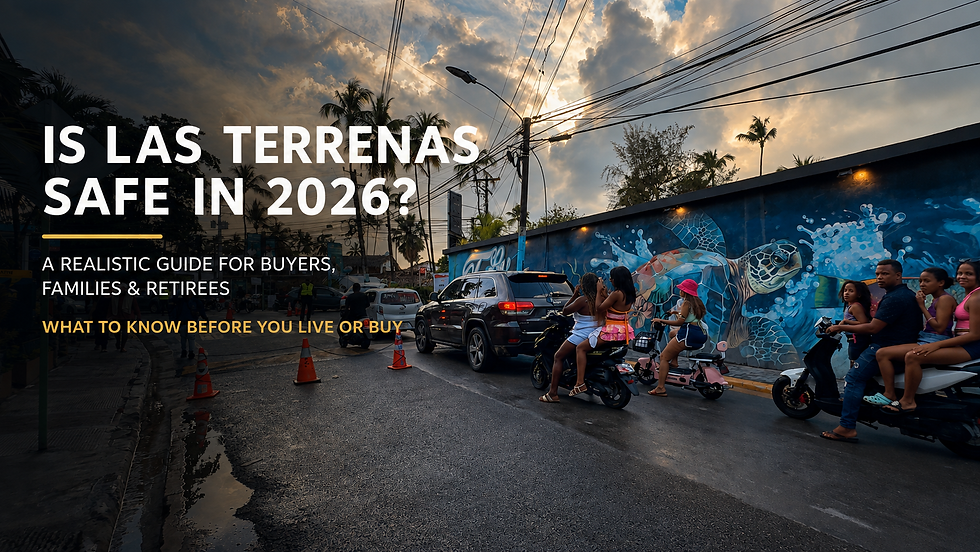
Is Las Terrenas safe? For most visitors and residents who use normal precautions, Las Terrenas can be a comfortable place to visit and live — but we would never describe it as completely risk-free.
That would not be honest.
The Dominican Republic is currently under a Level 2 – Exercise Increased Caution advisory from the U.S. Department of State because of crime. The advisory says crime is a concern throughout the country while also noting that tourist destinations generally receive more police presence and that the Dominican Republic has a dedicated tourist police force, POLITUR.
That sounds serious. But it is important to understand what Level 2 actually means. It does not mean: “Do not travel.”
The U.S. system has four levels:
Level 1: Exercise normal precautions
Level 2: Exercise increased caution
Level 3: Reconsider travel
Level 4: Do not travel
The Dominican Republic is currently at Level 2. So the useful question isn’t: “Is Las Terrenas perfectly safe?” No town can honestly promise that. A much better question is:
“What are the real risks, and how does everyday life here actually work?”. That is what we will answer.
First: Is Las Terrenas Considered a Dangerous Place for Tourists?
Las Terrenas is one of the Dominican Republic's established tourism destinations, and there is a visible tourist-police presence in tourism zones.
POLITUR officially operates nationally in the country's tourism centers, and its own website specifically documents agents operating in Las Terrenas. The service is available to both Dominican and international tourists.
But tourism does not create an invisible safety bubble.The U.S. State Department warns about robbery and other violent crime across the Dominican Republic and recommends paying attention to your surroundings, keeping valuable items discreet and not resisting if robbed.The UK government gives similar advice, particularly around opportunistic theft, phones, jewellery, isolated areas and nighttime movement.
So our answer is:
Las Terrenas is not a place where we would tell someone to be afraid of normal everyday life.
But it is also not a place where we would advise walking around at 2 a.m. with your phone in your hand, expensive jewellery visible and no awareness of your surroundings.
Common sense still matters.
The Biggest Difference: Vacation Safety vs Living Here
Someone visiting Las Terrenas for five days sees the town very differently from somebody living here for five years. A tourist usually moves between:
hotel → beach → restaurant → excursion → hotel
A resident also thinks about:
where to park, where to walk at night, how the house is secured, whether the road is illuminated, who has access to the residence and how far the property is from other homes.
That is why safety should also be part of the property-buying decision. A beautiful villa and a comfortable villa are not always the same thing.
Is It Safe to Walk Around Las Terrenas?
During the daytime, the main areas of Las Terrenas are busy with: residents, tourists, scooters, shops, restaurants and normal daily activity. That doesn't mean you should stop paying attention.
Official travel advice recommends keeping expensive jewellery discreet and being careful with visible phones and valuables in public areas.
Our simple rule during the day: Live normally. Just don't advertise everything valuable you own. You don't need to hide your phone every time you leave home.But standing next to a road with an expensive phone loosely in your hand while being completely distracted is unnecessary. The same is true for: wallets, handbags, expensive watches and large amounts of cash.
What Changes at Night?
This is where we would use more caution. There is a big difference between:walking along a busy restaurant area at 8 p.m.and walking alone down an empty, poorly lit road at midnight.
Official UK travel advice recommends avoiding remote areas, particularly after dark, while U.S. guidance advises travelers to remain aware of their surroundings and travel with another person or group when possible. That is practical advice for Las Terrenas too. If the road is: dark, empty, isolated or unfamiliar, take a taxi, drive or go with someone. There is very little upside to proving that you can walk somewhere alone at 1 a.m.
Is the Beach Safe at Night?
This is another question people rarely ask before arriving. During the day, the beaches are one of the main reasons people live here. At night, the situation changes. A busy beachfront restaurant area is very different from an empty stretch of beach with no lighting and nobody around. We would not recommend walking long, isolated sections of beach alone late at night. Not because Las Terrenas beaches suddenly become “dangerous” after sunset. Simply because:
less light + fewer people + more isolation = less help if something happens.
The same logic applies almost anywhere in the world.
Punta Popy, Las Ballenas, Bonita or Cosón: Which Area Is Safest?
We would not rank Las Terrenas neighborhoods with a fake safety score. There isn't a reliable neighborhood-level crime dataset we would be comfortable using to tell someone:
“Punta Popy is 8/10 safe but Cosón is 6/10.” That would create false confidence. Instead, look at the specific property and exact street. For example: a villa in Cosón inside a controlled-access residence with lighting, neighbors and security can feel very different from an isolated standalone house. Likewise, a condo in Punta Popy inside a residence can feel completely different from a house on a dark road farther inland. So when we evaluate a property, we look at: the neighborhood + the road + access + lighting + neighbors + property security
rather than using the area name alone.
Does Living in a Gated Community Make a Difference?
It can. A gated residence may provide some combination of:
Controlled entrance
Security personnel
Cameras
Lighting
Neighbors nearby
Visitor control
Enclosed parking
That can be particularly attractive if you are: a family, a foreign owner who travels frequently or someone buying a vacation property that may sit empty between visits. But again: “Gated” does not automatically mean “secure.” Ask what actually exists:
Is there a guard 24 hours? Or only at night?
Are visitors registered?
Are cameras operating?
Who has access?
Is the entrance genuinely controlled or is the gate permanently open?
The word security in a brochure is much less useful than knowing how the residence actually operates.
What about renting an Independent Villa?
You can absolutely live comfortably in an independent villa. You simply need to think more carefully about the property itself. We would look at:
- doors and windows
- exterior lighting
- perimeter
- parking
- camera system
- alarm
- whether neighboring homes are occupied
- who has access to the property
- how the villa is managed when you're outside the country
A huge isolated property can look incredible online. Then you arrive and realize your nearest neighbor is barely visible and the access road becomes completely dark after 7 p.m. Some buyers love that privacy. Others suddenly feel uncomfortable. Neither person is wrong. It depends on what makes you comfortable.
One Security Detail Foreign Buyers Sometimes Forget: Staff Access
This isn't about distrusting everyone who works at your home. It is about basic property management. A villa can have: cleaners, gardener, pool maintenance, electrician, property manager, Airbnb manager and repair workers coming through at different times.
So ask:
Who has keys?
Are keys ever changed?
Who can authorize access?
What happens when the property is empty?
Does someone inspect it regularly?
This becomes even more important with vacation rentals. Good security is not only a wall and camera. It is also knowing who can enter your property and when.
What About Apartments and Condos?
For many foreign owners, condos can be simpler. You may have: reception, common security, cameras, controlled parking and other residents nearby.
This is particularly useful for a lock-and-leave property. You arrive. Use it for three months. Lock the door. Leave the Dominican Republic. The residence continues operating around your unit. But don't assume every condo provides the same level of security.
Ask the same questions you would ask about a villa.
Is Theft a Bigger Concern Than Violent Crime?
For everyday life, one of the easiest risks to reduce is opportunistic theft. Official U.S. and UK travel guidance specifically recommends being careful with phones, jewellery, cash, handbags and items left unattended. Some of the simplest habits make a difference: don't leave your phone on the edge of a restaurant table beside the street. Don't leave a handbag unattended on the beach while swimming. Don't leave laptops or cameras visible inside a parked vehicle. Don't carry large amounts of cash unnecessarily. Don't leave scooter keys in the scooter because you're “only going inside for one minute.”None of that requires living nervously. It is simply making yourself a less convenient target.
What If Someone Tries to Rob You?
Official U.S. and UK guidance is very clear on this: do not resist if doing so could put you at greater risk. Your phone can be replaced. Your bag can be replaced. You cannot. This is one situation where protecting the object should never become more important than protecting yourself.
Road Safety May Be the Risk Buyers Underestimate Most
When people ask: “Is Las Terrenas safe?” they usually mean crime. But living here involves another risk that deserves just as much attention:Traffic. Scooters and motorcycles are everywhere in Las Terrenas. They are fast, convenient and cheap. They are also something you should treat seriously. The U.S. State Department warns that road conditions and driving behavior in the Dominican Republic can be dangerous, highlighting motorcycles, speeding, weak enforcement and inconsistent driving behavior. UK travel advice also specifically warns that the Dominican Republic has a high road-accident death rate and recommends particular caution on motorcycles and scooters.
So if you're moving here and buying a scooter because: “Everyone has one,” please don't copy every habit you see:
- Wear the helmet.
- Slow down.
- Be careful at intersections.
- Do not assume someone will stop because you have priority.
- And use much more caution at night.
Driving at Night Is Different Too
Outside the busiest parts of town, lighting can vary considerably. Official travel guidance warns about nighttime driving because of: poor lighting, pedestrians or animals, vehicles without proper lights and uneven road conditions.
This matters especially if you are considering a property: in the hills, outside the center or in other less dense areas. Do the drive twice before buying: once during the day and once at night. A road that feels completely normal at 11 a.m. can feel very different at 10 p.m.
That simple test tells you more than looking at the location on Google Maps.
Families: Would We Feel Comfortable Raising Children Here?
For many families, yes. But family safety is about more than crime.Think about:
- road traffic
- pool safety
- beach and ocean conditions
- property stairs and balconies
- gated access
- how children get to school
- medical access
- who supervises them
For younger children especially, traffic and water may be more relevant daily concerns than street crime. UK travel advice notes that lifeguards may not always be present on beaches and that sea conditions can become dangerous. And in reality - we didn’t see any lifeguards here in Las Terrenas at all. A beachfront lifestyle is wonderful. But “the beach is outside the door” also means parents need clear rules around the water.
What About Retirees?
Retirees often have slightly different priorities. You may care less about nightlife and more about: easy access, good lighting, parking, stairs, medical care and having other people around.
For a retiree buying here, we would ask:
Can you comfortably enter and leave the property at night?
Can you reach shops without riding a scooter if you don't want to?
Is there someone nearby if you need help?
Does the residence have security or management?
Can an ambulance or vehicle easily reach the property?
A spectacular mountain villa may be perfect for one retiree. Another may be much happier in an apartment near Punta Popy where normal life is easier. Safety is also about how easy life is when something goes wrong.
What About Solo Women?
This is an important question and one we would not answer with: “Don't worry, everything is safe!” Women live, work and travel independently in Las Terrenas every day.
At the same time, the normal precautions we already discussed become more important when moving alone: avoid isolated places late at night, arrange trusted transport when needed, let somebody know where you are when going somewhere unfamiliar and be careful about meeting strangers in secluded locations. The U.S. advisory specifically warns travelers to be cautious when meeting people first contacted online, especially in isolated locations. The goal is not fear. It is removing unnecessary risk.
Would We Leave Things on the Beach While Swimming?
Expensive things? No. You do not need to bring: passport + laptop + all your credit cards + $1,000 cash to spend two hours at Playa Popy. Take what you need. Keep important items together.
If several people are together, one person can keep an eye on the belongings. Again: very simple habit. Potentially very useful.
What About ATMs and Cash?
You don't need to carry large amounts of cash every day. Official travel guidance recommends keeping cash and valuables discreet. Use ATMs in normal, visible locations.
Don't stand in the street counting a large amount of money. And if you are purchasing property, never treat a large real-estate transaction like a normal cash transaction.
Deposits and property payments should follow the documented process agreed with your lawyer, seller and financial institutions.
Emergency Numbers You Should Actually Save
This section is worth screenshotting. Emergency — 911
For police, ambulance or fire emergencies, dial - 911
The U.S. State Department currently states that 911 works throughout the Dominican Republic except for some areas close to the Haitian border.
Tourist Police — POLITUR
The Dominican Republic has a dedicated tourism police service.POLITUR publishes these contact numbers - 809-222-2026
and the tourist-assistance line - 809-200-3500
POLITUR states that its tourist assistance service is available 24 hours a day through its tourist-assistance centers. POLITUR also now provides a mobile app designed to connect tourists with assistance, nearby stations and emergency information.
Save the numbers before you need them. Not after.
Should You Buy a Property With Cameras?
Cameras can be useful. But a camera should not be the entire security strategy. We prefer a combination of: good location + controlled access + lighting + secure doors/windows + sensible property management with cameras as an additional layer. If you're buying a villa, also ask whether the camera system: actually works, records footage, can be accessed remotely and continues operating during a power interruption. A camera that hasn't recorded anything in two years is decoration.
What About Backup Electricity and Security?
This is something foreign buyers may not immediately connect. Imagine: your residence has an electric entrance gate, cameras, exterior lights, internet-based security, then electricity goes out.
What still works? Many modern residences and homes use some combination of: inverters, batteries, generators or solar systems.
When evaluating security, ask what happens during an outage. Not because a power outage automatically creates danger. Simply because a security system should ideally remain useful when the electricity is temporarily unavailable.
A Very Simple Property Safety Checklist
When you visit a property you might actually buy, forget the beautiful photos for five minutes. Look around:
How do you enter the property?
Who else can enter?
Is the road illuminated?
Are there occupied homes nearby?
Where will you park?
How are doors and windows secured?
Is there exterior lighting?
Does the residence have security?
Who watches the property when you're abroad?
How does the area feel after dark?
That last question matters. If possible: Visit again at night. You are buying the property for 24 hours a day. Not only for the 30 minutes your agent shows it to you at sunset.
Should Safety Change Which Area You Buy In?
Sometimes. But we would think about lifestyle first and property security second, rather than trying to identify one “safe neighborhood.”
For example:
Punta Popy / central areas. More activity and easier access to restaurants and services may appeal to someone who doesn't like isolated locations.
Las Ballenas. Can give a good balance between residential life and access to town.
Playa Bonita / Cosón. Can offer very private homes and communities, but the exact residence, nighttime access and transportation become more important.
El Portillo. Residential communities can be appealing for owners looking for managed access and a quieter setting.
Hills. Can offer incredible privacy and views, but road access, lighting and isolation should be checked carefully. These are lifestyle observations, not crime rankings.
The exact property always matters more.
Is Las Terrenas Safer Inside Tourist Areas?
Tourist destinations in the Dominican Republic are generally more heavily policed than metropolitan or rural areas, according to the U.S. State Department, and the country maintains a dedicated POLITUR force for tourism areas.
But that doesn't mean: tourist area = nothing can happen
or
residential area = unsafe. Think of police presence as one extra layer. Not a guarantee.
What We Would NOT Do in Las Terrenas
We wouldn't:
- walk alone down isolated roads late at night if an easy transport option exists
- leave expensive electronics unattended on the beach
- ride a scooter without a helmet because everyone else is doing it
- leave cameras, laptops or bags visible inside a parked vehicle
- buy an isolated villa without seeing the access road after dark
- advertise online that our property will be empty for the next two months
- give property keys casually to multiple people without knowing who has access
None of those choices would improve our quality of life. So why take the extra risk?
What We WOULD Do
We would:
- live normally
- enjoy the beaches
- walk through town
- go to restaurants
- drive around the peninsula
- use common sense with valuables
- take transport late at night when appropriate
- wear a helmet
- know our neighbors
- secure the property properly
- save 911 and POLITUR contacts
That is a much more realistic picture of living here. Not fear. Not pretending nothing ever happens. Just normal awareness.
Would Safety Stop Us From Buying Property in Las Terrenas?
No.
Safety alone would not stop us from buying here. But it could absolutely change which property we buy. We might reject an amazing villa because the access road feels too isolated. We might prefer a condo with controlled access because we travel frequently. We might choose a slightly busier area because we want to walk to restaurants at night.Or we might happily choose a private hillside home because we value space and are comfortable driving.
That is the key point: don't ask only whether Las Terrenas is safe. Ask whether this exact property fits the level of security and independence you are comfortable with.
That gives you a much better answer.
Is Las Terrenas Safe for a Vacation?
For most travelers using normal precautions, Las Terrenas remains a major tourism destination where normal vacation activities continue every day. But current international travel advice for the Dominican Republic recommends increased caution because of crime. So: enjoy the beach, enjoy dinner, explore, take excursions. Just don't switch off your normal awareness because you're on vacation. Paradise is still part of the real world.
Is Las Terrenas Safe to Live in Full-Time?
It can be. But full-time residents eventually stop thinking about “tourist safety” and start building normal habits. You learn: which roads you prefer at night, where you park, how your home works, who your neighbors are, who you call when something happens, and when it is easier to drive rather than walk.That is normal life in a new country. The goal is not to spend every day thinking about security. The goal is to set up your life so you don't need to think about it constantly.
Thinking About Moving or Buying in Las Terrenas?
When helping someone choose a property, we believe safety should be discussed the same way we discuss: the beach, view, HOA, rental potential, water, electricity and road access. It is part of the property.
At TerrenasRD Real Estate, we can help you compare not only what a home looks like in the listing, but how the location actually feels and works: during the day, after dark and when you're living here rather than simply visiting.
Because buying confidently is not about someone telling you:
“Don't worry. Everything is safe.”
It is about understanding the location, understanding the property and deciding whether you would genuinely feel comfortable living there.That is a much better standard.
This article provides general safety information and practical observations for Las Terrenas in 2026. Safety conditions can change and can differ from one street or property to another. Always check current official travel advice before travelling, and contact local authorities in an emergency.

Comments