
10 Things to Check Before Buying Beachfront Property in Las Terrenas

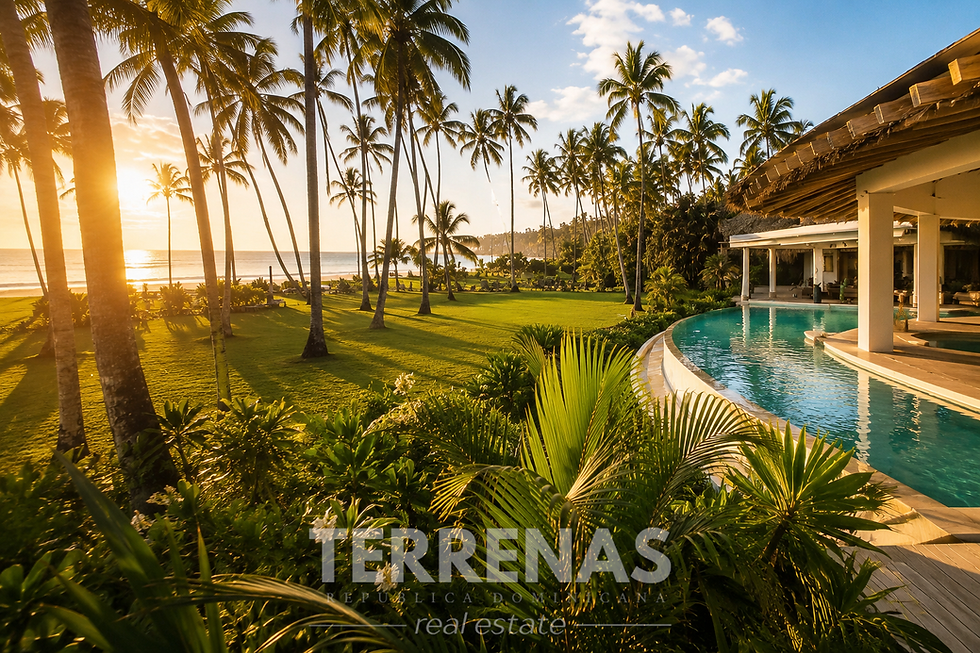
Beachfront property in Las Terrenas can be incredible — but being directly on the ocean adds questions that you would not necessarily ask when buying a property farther inland.
You are not only buying: the apartment, villa or land. You are also buying its relationship with: the beach, water, weather, access, salt, drainage and surrounding development. That is why we would never recommend choosing beachfront property only because: “The view is amazing.” The view matters. But before sending a large deposit, we would want clear answers to the following 10 questions.
1. Is the Title Clear — and Does the Property Match What You Are Being Shown?
Start with the boring part. Because it is also the important part.
The Dominican Registro Inmobiliario defines a Certificate of Title as the official document issued and guaranteed by the Dominican State that proves the existence and ownership of a registered real-estate right. It also allows buyers to request a Certificación de Estado Jurídico del Inmueble, which can show registered charges or encumbrances affecting a property.
For beachfront land especially, don't stop at:“Yes, there is a title.” Ask your lawyer to verify:
Who is the registered owner?
Is the seller legally able to sell?
Are there mortgages or liens?
What exact parcel is included?
Does the cadastral plan correspond to the land you physically visited?
Is the property individually titled?
Is there a deslinde issue?
The Registro Inmobiliario explains that a deslinde is the process used to individualize property rights supported by a Constancia Anotada, register the individual survey and obtain a Certificate of Title for the defined parcel. Why this matters more with beachfront land?! Imagine someone shows you: 2,000 m² with 40 meters of beach frontage. Those numbers sound fantastic. But your lawyer and surveyor need to confirm that the legal parcel actually corresponds to those boundaries. Don't buy the palm trees somebody points at. Buy the land described in the legal documents.
2. Where Exactly Is the Legal Coastal Protection Area?
This is one of the biggest differences between normal property and beachfront property in the Dominican Republic.
Dominican coastal rules protect a 60-meter strip measured from the high-tide line — the pleamar. The Ministry of Environment states that Law 305-68 establishes this protected coastal strip and restricts construction within it without the required prior environmental evaluation and authorization. The Ministry also describes the purpose of the rule as protecting coastal ecosystems, scenery and public access to beaches.
And this is not an old rule nobody pays attention to. In April 2026, the Ministry again publicly reminded the country about protection of the 60-meter coastal strip. It has also specifically taken action in Las Terrenas, including Playa El Anclón, regarding use of the protected area.
Before buying, ask:
Where is the official high-tide line?
Where does the 60-meter protection area fall in relation to this property?
Are existing structures properly authorized?
Can additional construction actually be done where the seller says it can?
This is particularly important if you are buying: land to build a villa or an older beachfront home you plan to expand. A big lot does not automatically mean every square meter can be built on.
3. Do You Really Have the Access You Think You Have?
There are actually two types of access to think about. Access to your property. Can you legally and practically reach it? Look at:
Road access
Registered easements where relevant
Parking
Delivery access
Emergency vehicle access
What happens during heavy rain
Whether the access crosses somebody else's property
An amazing beachfront lot becomes much less interesting if reaching it depends on an informal path that nobody has properly documented.
Access to the beach. Be especially careful with phrases such as: “private beach” or “exclusive beach.” A residence may have private access, private facilities or a beach club reserved for residents. That is different from assuming the actual shoreline can simply be closed to everyone.
The Ministry of Environment describes protection of the 60-meter coastal strip as also serving the purpose of guaranteeing public access to Dominican beaches.
So ask what “private” actually means in that particular project.
- Private gate?
- Private beach club?
- Private path?
- Or supposedly private shoreline?
Those are not the same thing.
4. What Happens Here During Very Heavy Rain?
Visit a beachfront property on a perfect sunny January afternoon and almost everything looks good. The more useful question is: What happens after several hours of tropical rain? Look for:
- where water enters
- where it drains
- whether the road floods
- whether the garden holds water
- whether underground parking takes water
- where roof water is directed
- whether the property sits lower than the road
Ask the owner, neighbors, property manager and maintenance team. One simple question can tell you a lot: “What happened here during the last really heavy rain?” Don't ask only the person selling the property. If possible, ask somebody who has actually lived there.
5. Has the Beachline Changed?
A beachfront buyer sees sand and naturally assumes: “The beach will always look exactly like this.” Be careful with that assumption.The Dominican Ministry of Environment describes beaches as dynamic ecosystems where sand is naturally deposited and removed through waves, currents and wind. In simple language: Beaches move. Some become wider during certain periods. Some become narrower. Storms can temporarily or permanently change sections of shoreline.
Coastal science also shows that storm surge and waves can cause beach erosion and can undermine foundations and infrastructure close to the coast. That does not mean every beachfront property in Las Terrenas has an erosion problem. It means you should investigate the specific beach.
What would we do?
- Look at older photographs.
- Look at historical satellite imagery.
- Talk with neighbors who have been there for years.
- Ask whether sand has been added or removed.
- Look for retaining walls or other shoreline structures and ask why they exist.
- Ask whether waves have ever reached the garden, pool or building.
If you're buying an expensive oceanfront villa, it can also be worth having an engineer familiar with coastal property inspect the site. The ocean view is obvious. The history of the shoreline isn't.
6. How High Is the Property Above the Water?
Two homes can both be advertised as: “Beachfront.” But one may sit several meters above the beach. The other may be almost level with the sand. Those are very different situations.
Storm surge is water pushed above the normal tide level during storms, and waves on top of that elevated water can increase damage along exposed coastlines. So when evaluating a beachfront property, don't only measure: distance to the sea. Consider: elevation above it.
Look at:
Ground-floor elevation
Pool elevation
Electrical equipment
Generator/inverter location
Underground spaces
Storage rooms
Parking
Drainage
Road elevation
And ask: “Has water ever entered this property?” If the answer is yes, that does not automatically mean you should reject it. It means you need to understand: when, why, how high and what was changed afterward.
7. Was the Property Actually Built for Life Beside the Ocean?
Beachfront looks beautiful. Salt air is less romantic. Living next to the sea exposes buildings and equipment to a much harsher environment than living several kilometers inland. That is why we would never inspect a beachfront property only from the living room. Look closely at:
- metal railings
- external A/C units
- electrical panels
- window frames
- sliding doors
- roof elements
- pool equipment
- outdoor furniture
- screws, hinges and fittings
- concrete cracks
You are looking for: rust, corrosion, swelling, peeling paint, damaged seals and areas where water repeatedly enters. For a newer project, ask what materials and systems were selected specifically for a coastal environment. For an older property, ask: What has already been replaced? A beautiful oceanfront home can still be a good purchase with ongoing maintenance. You simply need to know what maintenance you're signing up for.
8. How Do Water, Electricity and Wastewater Work?
Never assume: “It's an expensive beachfront project, so everything must work perfectly.” Ask.
Water:
- Where does the water come from?
- Is there a cistern?
- How large?
- Is there a pump?
- What happens if supply is interrupted?
Electricity:
- Does the property have: inverter + batteries, generator, solar or another backup system?
- What remains powered during an outage? A/C? Fridge? Water pump? Security gate?
Wastewater:
- How is wastewater treated?
This is particularly important close to the coast. The Ministry of Environment's current environmental-authorization process requires development projects to identify their sources of water and electricity and describe wastewater treatment and final disposal, among other infrastructure details.
For a newer beachfront development, these are exactly the kinds of systems we would want to understand before buying. Not after moving in.
9. What Will This Property Actually Cost to Own Every Year?
Beachfront has another difference: The purchase price is only the beginning. Before buying, build a simple annual ownership budget. Include:
- HOA
- Insurance
- A/C servicing
- Salt-air maintenance
- Painting
- Pool maintenance
- Garden
- Security
- Internet
- Electricity
- Property management
- Repairs
If it is a condominium, ask for the current HOA fee and exactly what it includes. Then ask a more important question: “Are any large repairs or special assessments expected?” Beachfront residences may eventually need work on: facades, pools, roofs, pumps, common areas, sea-facing structures and landscaping. A low HOA is not always good news if the condominium is not reserving enough money for future maintenance.
Get insurance information before you buy. Don’t wait until closing to discover that the insurance available for the property is different from what you expected. Before committing to an expensive beachfront home, ask an insurance broker for a real quotation for that exact property.
Ask what is covered.
Ask what is excluded.
Ask about: hurricane, wind, flooding, contents and deductible.
Don't assume: “I have home insurance, therefore absolutely everything connected with a storm is covered.” Read the actual policy. For a large investment, the difference matters.
10. What Can Be Built Next Door?
This is one of our favorite questions because buyers often forget to ask it. Imagine: You buy a condo for its incredible ocean view. There is an empty lot next door. You assume: “Perfect. Nothing there.” Two years later: construction begins. Now your view, privacy, noise and even rental appeal may change.
Never treat an empty lot as a permanent view. Instead ask:
- Who owns it?
- What is its land-use designation?
- What height and density may be allowed?
- Is a project already planned or approved?
- Are there construction permits or tourism approvals?
Dominican construction licensing currently requires documents including property title, cadastral plans, municipal land-use approval, architectural and technical plans, and a geotechnical study; depending on the project, tourism and environmental approvals may also be required.
For tourism projects, the Ministry of Tourism also provides an official system where the status of tourism-project approvals and land-use no-objection decisions can be checked.
You may not be able to predict every future project. But you can certainly investigate more than:“The agent said nothing is planned.”
One More Question: Do You Actually Need to Be Beachfront?
This is where we would challenge the buyer a little. Because: oceanfront is not automatically the best investment. Sometimes it is exactly what you should buy, if your dream is: open the door → walk onto the sand. Then being beachfront has real lifestyle value. You may happily pay more for it.
But if your main goal is investment return, compare it with properties:
- 100 meters
- 300 meters
or even
- 500 meters from the beach.
Why? Because a near-beach property can sometimes offer:
- a lower purchase price
- lower exposure to salt and waves
- simpler maintenance while still allowing guests or owners to walk to the beach in a few minutes. Imagine two properties:
Property A
-Direct beachfront
-Much higher purchase price
-Higher maintenance exposure
-Amazing view and direct sand access
Property B
-Three minutes' walk from the same beach
-Lower purchase price
-Pool
-Excellent condition
-Guests can still walk everywhere
Which is the better property? There is no automatic answer. For lifestyle? Maybe A.
For investment return? Maybe B.
For resale scarcity? Maybe A again.
This is why we would not pay a beachfront premium without understanding what that premium actually gives us.
Beachfront Condo vs Beachfront Villa.
These also need different thinking.
Beachfront condo. You may have:
Shared security
Shared pool
Shared landscaping
Building management
HOA
Common insurance or maintenance systems
That can make ownership easier when you're outside the country. But you need to understand the HOA and condominium rules.
Beachfront villa. You have more independence. But you may also personally manage:
Pool
Garden
Security
Exterior maintenance
Roof
Generator
Water systems
Beach-facing structures
The villa may give you more privacy. The condo may give you less responsibility. Neither is automatically better.
What If You Want to Airbnb the Property?
Then add another layer to the checklist. Before buying, ask:
Does the condominium allow short-term rentals?
Is there a minimum stay?
Can guests use every amenity?
How are guests registered?
Is there an extra rental or management fee?
Who handles check-in?
Can outside property managers enter?
Don't buy a property based on projected Airbnb income and then read the condominium rules afterward. Read them first. And remember something from our Las Terrenas Airbnb Investment Guide: gross revenue is not profit.
Beachfront can help a listing stand out. But the higher purchase price and operating costs still need to make financial sense.
Our Beachfront Due-Diligence Checklist
Before signing, we would want answers to all of these:
Is the Certificate of Title verified?
Has the legal status of the property been checked?
Do the survey and physical property match?
Is the coastal 60-meter protection area understood?
Are existing structures properly authorized?
Is road access clear?
Has the property flooded before?
Has the shoreline changed significantly?
What is the property's elevation?
Has a professional inspected the construction?
What maintenance is caused by the coastal environment?
How do water and wastewater work?
What backup electricity exists?
What exactly does the HOA include?
Are major HOA expenses expected?
Have you obtained an insurance quotation?
Are short-term rentals allowed if you need them?
What can legally be built on neighboring land?
That sounds like a lot. For a beachfront property worth several hundred thousand — or several million — we think it is reasonable.
The Biggest Beachfront Buying Mistake
The biggest mistake is allowing the ocean to make the decision for you. It happens easily. You walk onto the terrace. Beautiful blue water. Palm trees. You imagine breakfast there, your family visiting, the Airbnb photos. And suddenly: everything else feels less important.
That is exactly when you need to become more practical. The sea will still be beautiful after:
- your lawyer checks the title,
- your engineer inspects the building,
- you read the HOA documents,
- you obtain insurance information,
and you understand the coastal restrictions. If the property still makes sense after all of that? Then you can enjoy the view with much more confidence.
So, Is Beachfront Property in Las Terrenas a Good Investment?
It absolutely can be. Beachfront land is limited. People come to Las Terrenas largely because of its coastline. Direct access to beaches such as Playa Bonita, Cosón, Las Ballenas, Punta Popy or El Portillo can create strong lifestyle appeal. But:“Beachfront” should never replace due diligence.
Sometimes the right answer is the oceanfront villa. Sometimes it is the condo one row behind it. The goal is not to buy the property closest to the water. The goal is to buy the property you will still be happy to own after the excitement of the first sunset wears off.
Thinking About Buying Beachfront Property in Las Terrenas?
At TerrenasRD Real Estate, we work with beachfront, near-beach and ocean-view properties throughout Las Terrenas. When comparing them, we believe buyers should look beyond:
the view and the asking price.
We help you compare:
location, beach access, property type, maintenance, HOA, rental potential, surrounding development and how the property actually fits your plans.
And for the legal, structural and insurance questions, we strongly recommend using the appropriate independent professionals before completing the purchase. Because beachfront property should feel exciting. The due diligence behind it should feel boring.
That is usually a very good combination.
This article is provided for general informational purposes and reflects information available in 2026. Coastal restrictions, environmental approvals, construction permissions, insurance terms and individual property conditions can vary. Buyers should obtain independent Dominican legal, surveying, engineering and insurance advice for the specific property they are considering.

Comments