
Las Terrenas & Samaná Are Changing: The 2026 Infrastructure Projects Buyers Should Know About

Las Terrenas is growing — and in 2026 some of the most important changes are happening outside the walls of new villas and condo projects.
Water. Sewer infrastructure. Roads. Tourism access. Cruise traffic. Public investment.
These may not look as exciting as a new beachfront development, but for someone considering buying property in Las Terrenas, they can be more important in the long term.
On April 10, 2026, the first stage of the new Samaná Bayport cruise terminal was officially inaugurated.
Then, on July 11, 2026, the Dominican government announced major plans for water and sanitation in Las Terrenas, including approximately RD$1.8 billion for expansion of the aqueduct, while also identifying the Sánchez–Las Terrenas road as an infrastructure priority.
So what does all of this actually mean?And more importantly:
What should a property buyer pay attention to — and what should you not assume?
Let's look at the changes one by one.
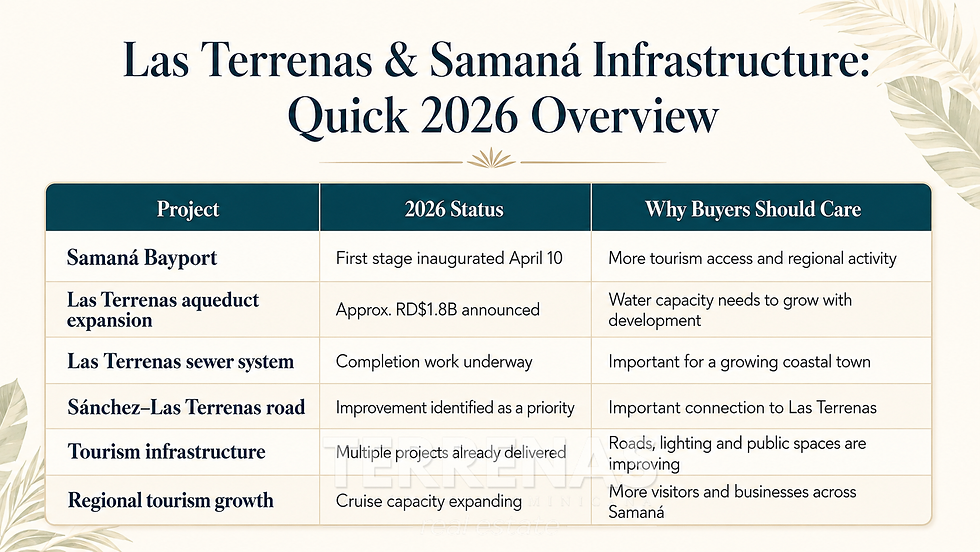
Las Terrenas & Samaná Infrastructure: Quick 2026 Overview
Project | 2026 Status | Why Buyers Should Care |
Samaná Bayport | First stage inaugurated April 10 | More tourism access and regional activity |
Las Terrenas aqueduct expansion | Approx. RD$1.8B announced | Water capacity needs to grow with development |
Las Terrenas sewer system | Completion work underway | Important for a growing coastal town |
Sánchez–Las Terrenas road | Improvement identified as a priority | Important connection to Las Terrenas |
Tourism infrastructure | Multiple projects already delivered | Roads, lighting and public spaces are improving |
Regional tourism growth | Cruise capacity expanding | More visitors and businesses across Samaná |
Some of these improvements are already here, while others are still being built or planned. That distinction matters when buying property: it is always better to base your decision on what works today and see future infrastructure as an additional potential benefit
1. Samaná Bayport Is Now Open
This is probably the biggest visible tourism-infrastructure change in Samaná in 2026.
On April 10, 2026, the Dominican government officially inaugurated the first of three planned stages of Samaná Bayport, a new cruise terminal and tourism complex in Santa Bárbara de Samaná.
This is not simply a small dock. The completed project is designed to handle up to three cruise ships at the same time.
One vessel of up to approximately 5,000 passengers can use the floating SeaWalk pier, while two additional ships can operate from the anchorage using tenders.
The terminal also includes or plans facilities such as restaurants and food outlets, commercial areas, a beach club, pool, recreation areas, transportation for excursions and tourist information services.
And cruise ships were already arriving before the official opening
By the April inauguration, Bayport had already handled 22 cruise calls and around 50,000 passengers since December 2025. The government's announcement projected approximately 45 cruise calls and 90,000 passengers for the following season.
That makes this more interesting than a project that exists only on paper. It is already operating.
What Does Samaná Bayport Mean for Las Terrenas?
First, let's be clear:
Samaná Bayport is not in Las Terrenas.
It is in Santa Bárbara de Samaná. So a new cruise terminal does not suddenly mean thousands of cruise passengers will be walking down Playa Bonita every morning.
The effect is more regional.
The official project specifically connects arriving visitors with excursions and attractions around the peninsula, including Cayo Levantado, Los Haitises, Las Galeras and El Limón.
For the wider Samaná Peninsula, that potentially means more demand for:
restaurants, tours, transportation, guides, shops, excursions and other tourism businesses. And that is the part property buyers should watch.
Why?
Because destinations rarely grow because of one building. They grow when access + infrastructure + businesses + tourism + housing begin developing together.
Bayport is one more piece of that larger picture.
Does the New Cruise Port Mean Las Terrenas Property Prices Will Rise?
Not automatically.
And we would be careful with anyone telling you otherwise. A cruise port opening in Samaná does not guarantee that a condo in Las Terrenas will increase by 20% next year.
Real-estate prices depend on many things: location, supply, demand, interest rates, construction quality, tourism, infrastructure, rental performance and the general economy.
But large infrastructure projects can change how a region develops over time. That is why we consider Samaná Bayport something worth monitoring, rather than something buyers should use as a guaranteed appreciation calculation.
2. Las Terrenas Is Getting a Major Water-System Expansion
This may be less glamorous than a cruise terminal. For residents and property owners, it may be more important.
On July 11, 2026, during a government meeting in Samaná, INAPA director Wellington Arnaud said that the distribution of drinking water in Las Terrenas would be improved through an expansion of the aqueduct. The announced investment:
Approximately RD$1.8 billion
The government also stated that more than RD$1 billion had already been invested in water infrastructure across Samaná province during the previous six years.
Why does that matter? Because Las Terrenas today is very different from Las Terrenas twenty years ago. There are more: homes, villas, apartment developments, hotels, restaurants, pools and full-time residents. All of them need water.
Water Is a Real-Estate Issue
When people buy property, they naturally focus on:
How many bedrooms?
How close is the beach?
Does it have an ocean view?
But there is another question we encourage buyers to ask:
“How does this property get its water?”
That answer can change from one property or development to another. Depending on the location, a property may rely on public supply together with cisterns, storage tanks, pumps or other systems.
That is why improving the larger water network matters. It is not something you necessarily see in a beautiful real-estate photograph.
But you definitely notice when it doesn't work.
Does the RD$1.8 Billion Mean the Problem Is Already Solved?
No.
This distinction is important. As of the government's July 11 announcement, the RD$1.8 billion was an announced investment for expansion of the aqueduct.
That does not mean every part of Las Terrenas suddenly has perfect water pressure today. Infrastructure takes time to build. And individual properties can still have very different systems.
So if you are buying now, don't simply ask: “Is Las Terrenas improving the water system?”
Ask:
“What is the water situation in this exact property today?”
Future improvements are good. Your villa still needs water tomorrow morning.
3. The Las Terrenas Sewer System Is Also Being Addressed
Water supply is only half of the story. For a fast-growing coastal destination, wastewater treatment and sewer infrastructure matter enormously.
During the same July 11 meeting, the director of INAPA said work was being carried out on the Las Terrenas sewer system and projected completing the system within approximately two months, while adapting it to the town's population growth.
Because we are writing this in August 2026, we would describe the project as work in progress, not as completed. That distinction matters.
Why should a real-estate buyer care about sewage?
Because Las Terrenas is a beach destination. Growth without proper sanitation eventually creates problems for: residents, beaches, waterways, tourism and property owners.
More construction has to be accompanied by better infrastructure. Otherwise growth becomes a weakness rather than an advantage.
This Is Actually One of the Most Important 2026 Announcements
It probably won't receive as many Instagram likes as a new resort. But consider what you actually need to support a growing town:
more homes → more people → more water use → more wastewater
That chain is unavoidable. So when we evaluate the future of Las Terrenas, we pay attention not only to how many new developments are being launched.
We also watch whether the public infrastructure is catching up. That tells us much more about whether growth is becoming sustainable.
4. The Sánchez–Las Terrenas Road Is Back on the Agenda
Another important point from the government's July meeting was the road connecting Sánchez and Las Terrenas.
President Luis Abinader specifically highlighted the importance of improving the internal road between the two municipalities.
This connection matters because Sánchez sits on the southern side of the peninsula, while Las Terrenas is on the north coast. It is one of the important land connections into Las Terrenas.
But here's the part buyers should understand:
The July announcement identified improvement of the road as important.
It did not, in that statement, provide a finished project, construction completion date or detailed new budget for the road. So we would not advertise:
“New Sánchez–Las Terrenas highway coming soon!”
That would go beyond what was actually announced. The correct description today is:
The Sánchez–Las Terrenas connection has been identified by the government as an infrastructure priority to improve.
And now it is worth watching what happens next.
Why This Road Matters More Than It May Seem
Las Terrenas does not exist alone. Property owners here regularly move between:
Las Terrenas, Sánchez, El Catey International Airport, Samaná, Santo Domingo and other parts of the country. Road quality affects: travel time, logistics, construction deliveries, tourism, airport transfers and normal daily life.
For someone buying land or developing property, road infrastructure matters even more. Moving cement, steel, windows, machinery and workers is very different from moving two tourists with suitcases.
5. Some Improvements Have Already Happened
Not every infrastructure story is about something promised for the future. Tourism infrastructure has already been receiving investment across Samaná.
In July 2025, the Ministry of Tourism reported that more than RD$1.8 billion had been invested in 21 tourism-infrastructure projects across Samaná province, with 17 delivered at that time.
One Las Terrenas example is the improvement of Francisco Alberto Caamaño Deñó Street, running from the Pueblo de los Pescadores toward the Golf Project area.
The project included road repairs and the installation of lighting along approximately 2.45 kilometers, with an investment of about RD$30.7 million.
This is the kind of infrastructure improvement residents actually notice. Better lighting. Better roads. Safer movement at night. Improved access to businesses and residential areas. Not revolutionary on its own. Useful every day.
6. Samaná Is Becoming More Connected as a Destination
The bigger story is not one project. It is the combination. In only a relatively short period, Samaná has seen:
- a new cruise terminal operating,
- tourism road and lighting improvements,
- major water investment announced,
- sewer work progressing,
- and additional road improvements being discussed as priorities.
That does not mean Samaná is becoming Punta Cana. And we actually think that distinction is important. The appeal of Las Terrenas is very different. It is still a relatively small coastal town surrounded by beaches, hills and communities rather than a huge resort corridor. The challenge is:
Can infrastructure improve without losing what made people want to live here in the first place?
For us, that is one of the most important questions for the next several years.
What Does All This Mean for Property Buyers?
If you are thinking about buying in Las Terrenas in 2026, we would take three lessons from these developments.
1. Look Beyond the Property
A fantastic villa in a weak location is still affected by what happens outside its walls. Before buying, look at: road access, water, drainage, wastewater, electricity, surrounding development and future infrastructure.
2. Separate “Announced” From “Completed”
This is extremely important in real estate. We would classify infrastructure into three simple groups:
Completed
You can see it and use it today.
Example: the first phase of Samaná Bayport is open and operating.
Underway
Work has begun but is not finished.
Example: the sewer-system work discussed by INAPA in July.
Announced / Prioritized
Government has announced investment or said an improvement is a priority, but the finished result does not exist yet.
Examples include the approximately RD$1.8 billion aqueduct expansion and the prioritization of improvements to the Sánchez–Las Terrenas road.
Those three categories should never be mixed together.
3. Don't Pay Tomorrow's Price Only Because Someone Promises Tomorrow's Infrastructure
This is especially important with land and pre-construction. You may hear:
“This road will be completely redone.”
“Water is coming.”
“A new commercial center is planned.”
“The area is going to develop.”
Maybe. But your purchase decision should still make sense based on what exists today, with future infrastructure treated as potential additional value.
That is a much safer way to invest.
Which Parts of Las Terrenas Could Benefit Most From Better Infrastructure?
This is where things get interesting. Not every improvement affects every neighborhood equally.
Central Las Terrenas
Water, sewer, drainage, roads and traffic management matter heavily because this is where population and commercial activity are concentrated.
Punta Popy and Las Ballenas
Road improvements, lighting, sanitation and public-space investment directly affect both residents and visitors in these busy beach areas.
Cosón and Playa Bonita
Access and utility infrastructure become increasingly important as more residential projects and villas are built outside the traditional center.
El Portillo
Infrastructure matters as residential and tourism development continues east of town.
Hills around Las Terrenas
Here, buyers should pay particular attention to road quality, electricity and water at the individual property level rather than assuming town improvements automatically solve hillside access and utility questions.
The important word is individual. Two properties only 500 meters apart can have completely different infrastructure situations.
What About Sánchez?
Sánchez deserves more attention than it normally receives from Las Terrenas buyers. It sits on another side of the peninsula and has historically played a very different role from the beach tourism centers.
But improved connections between Sánchez and Las Terrenas, together with broader development across Samaná, make it worth watching. We would not say Sánchez is suddenly “the next Las Terrenas.”
That type of prediction is too easy to make and too difficult to prove. But investors looking at larger land parcels or longer-term opportunities should at least understand what is happening across the entire peninsula — not only within five minutes of Playa Popy.
Should You Invest in Las Terrenas Because of These Projects?
No — not because of the projects alone.
Buy because the property itself makes sense. Then consider infrastructure as another part of your decision. A good investment still needs:
a good location, sensible purchase price, clear legal status, real demand and a property people actually want to use.
Infrastructure can strengthen those fundamentals. It cannot replace them.
The Positive Sign We Are Watching
For us, the most encouraging part of the 2026 story is not one giant announcement. It is that the conversation is increasingly about the things a growing destination actually needs:
water, sanitation, transportation and regional access.
Those are less exciting than infinity pools. They are also much harder to fake in a sales presentation. Better infrastructure does not automatically guarantee property appreciation. But roads, water, sanitation and tourism access are exactly the developments serious buyers should monitor when evaluating a growing destination.
And in 2026, there is quite a lot to monitor in Las Terrenas and the wider Samaná Peninsula.
At TerrenasRD Real Estate, we look beyond the listing photos.
We help buyers compare: location, road access, utilities, surrounding development, property type, monthly costs and how the area actually works today.
Because a beautiful property is important.
But what surrounds it can be just as important.
This article was updated in August 2026 and distinguishes between completed projects, work in progress and government announcements. Infrastructure schedules, budgets and project scopes can change, so buyers should verify the latest status when making an investment decision.


Comments